
From Frustration to Understanding "Why": Abena Nyarko Frimpong on Redefining Leadership

Abena Nyarko Frimpong
Learning and Development Officer, Saha Global · Ghana
Mentee · WIW & RWSN · 24 October 2026
“I now see it differently. Good mentorship is not about someone giving you all the answers. It is about having someone who helps you ask better questions, see possibilities you may not have considered, challenge your assumptions, and take ownership of your growth.”
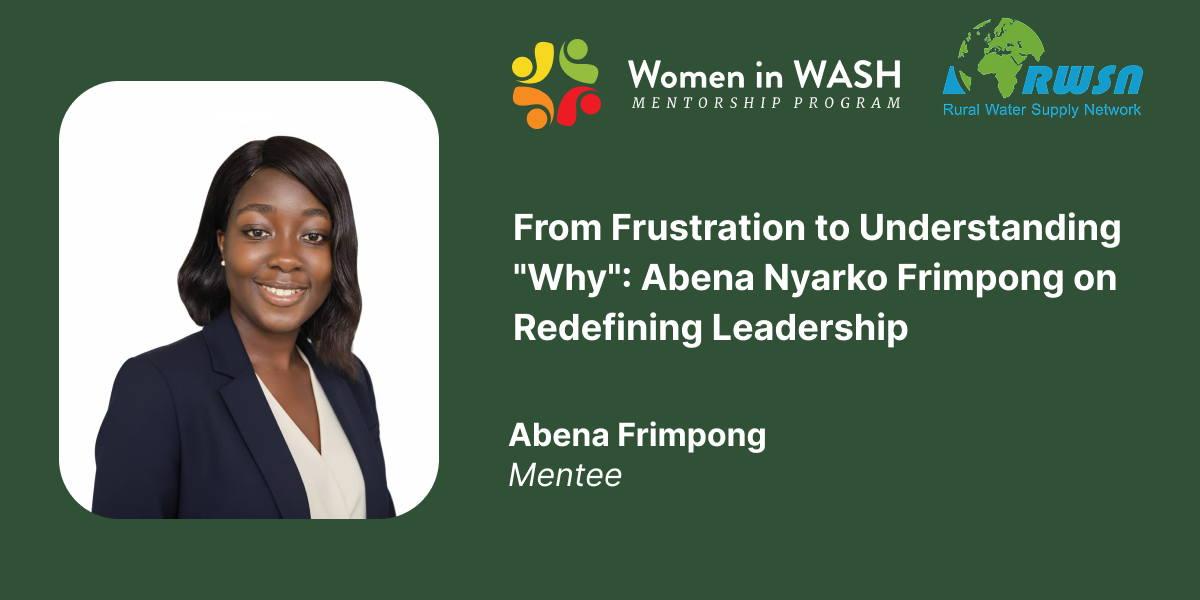
Abena Nyarko Frimpong is based in the Northern region of Ghana, where she works as a Learning and Development Officer at Saha Global, a WASH organisation working to improve access to safe water for last-mile communities. Her work focuses on staff learning and development, capacity building, and creating systems that help people and teams grow.
“I am particularly passionate about connecting learning with organizational impact, making sure that training is not just an activity, but something that strengthens people, improves performance, and contributes to the organisation’s mission.”
Abena joined the Women in WASH & RWSN mentorship programme as a mentee, matched with Hajia Alima.
Wanting to Invest in Her Own Growth
Abena’s motivation for joining came from a realisation about her own role. “As a Learning and Development Officer, I spend a lot of my time thinking about how to help other people develop. I realised that I also needed to invest intentionally in my own development.”
She was specifically looking for a mentor with experience in leadership, community development, and women’s and youth empowerment. “I also wanted to challenge myself to become more confident, strengthen my leadership skills, expand my professional network, and develop a clearer career direction within the WASH and development sector.”
A Relationship Built on Questions, Not Just Answers
What made the mentorship feel different to Abena was that it never felt one-directional. “Hajia Alima did not make the mentorship feel like a one-way conversation where she simply gave me advice. She encouraged me to reflect, ask questions, and think critically about my own goals.” She particularly valued the space it created for honest conversation. “I particularly appreciated that she created space for honest conversations about leadership, confidence, career growth, and the challenges women can experience as they grow professionally.”
A Shift From “Why Aren’t They Responding” to “What’s in the Way”
Abena describes a turning point that came from reflecting on a challenge in her own work. She had introduced a Professional Development Needs Assessment and Skills Matrix, and when the response was slower than she expected, she initially found herself frustrated. Through conversations during the mentorship, her framing shifted. “Instead of asking, ‘Why aren’t people responding?’, I started asking, ‘What might be preventing them from engaging?’”
She worked more closely with supervisors and coordinators, simplified her communication, extended the deadline, and focused on helping people understand the purpose behind the initiative. “That experience changed how I think about leadership. I realised that leadership is not just about creating good systems; it is about influencing people, building relationships, and helping people understand the ‘why.’ That is something I now carry into my work as a Learning and Development Officer.”
What Stood Out About Her Mentor
Abena points to three qualities in particular: experience, encouragement, and intentional questioning. “Hajia brought a wealth of experience from working in development, leadership, community development, and women’s empowerment. That experience gave me perspectives that I could not have gained from simply reading about leadership.”
She also credits the questions themselves as much as any answer. “Sometimes the most valuable part of mentorship was not receiving an immediate answer, but being asked a question that made me think differently about myself, my goals, or my approach to leadership.”
Rethinking What Mentorship Is
Abena’s view of mentorship shifted over the course of the programme. “Before the programme, I viewed mentorship mainly as an opportunity to receive guidance from someone more experienced. I now see it differently. Good mentorship is not about someone giving you all the answers. It is about having someone who helps you ask better questions, see possibilities you may not have considered, challenge your assumptions, and take ownership of your growth.”
She also came to see her own role in the relationship differently. “The experience also taught me that the mentee has to take responsibility for making the relationship valuable. I had to come prepared, reflect on my experiences, ask questions, and, most importantly, apply what I learned.”
Her Message to Anyone Considering the Programme
Abena’s advice starts with not waiting for a sense of readiness. “Don’t wait until you feel completely ready or until you have everything figured out.” She adds a note about ownership. “Don’t expect your mentor to do the work for you. Your mentor can open a door, share experience, and help you see things differently, but you have to walk through the door.”
Her Transformation in One Paragraph
Abena sums up her shift in perspective directly. “The biggest transformation for me was moving from thinking about leadership as what I do in my role to thinking about leadership as the influence and growth I create in others. The mentorship helped me become more intentional about my career goals, more reflective about my strengths and development areas, and more confident about taking action. I came into the programme wanting guidance; I left with a clearer vision of the leader I want to become and practical steps for getting there.”
She distills that shift into a single line. “Leadership is not the title I hold. It is the growth I create in the people I serve.”
What She Recommends
When asked for a book, tool or resource recommendation, Abena recommends exploring resources designed for development professionals and organisations,including platforms like LinkedIn.
“There are so many opportunities to learn, connect and grow professionally, and making the most of the resources available to us can support meaningful professional growth.” She particularly recommends using platforms and resources that support continuous learning, professional networking, and knowledge-sharing.
Her advice is to look beyond formal training and take ownership of your own development. “Don’t wait for your organisation to provide every learning opportunity. Explore resources that are relevant to your goals, learn from others, build your network, and consistently invest in your professional growth.”
