
Fixing the broken rung: how mentoring and sponsorship move women into management
The first step to manager is where women’s careers stall. The plain difference between mentoring and sponsorship, and a three-cycle ladder any organisation can run.
OneUpOneDown · 6 November 2026 · 9 min read
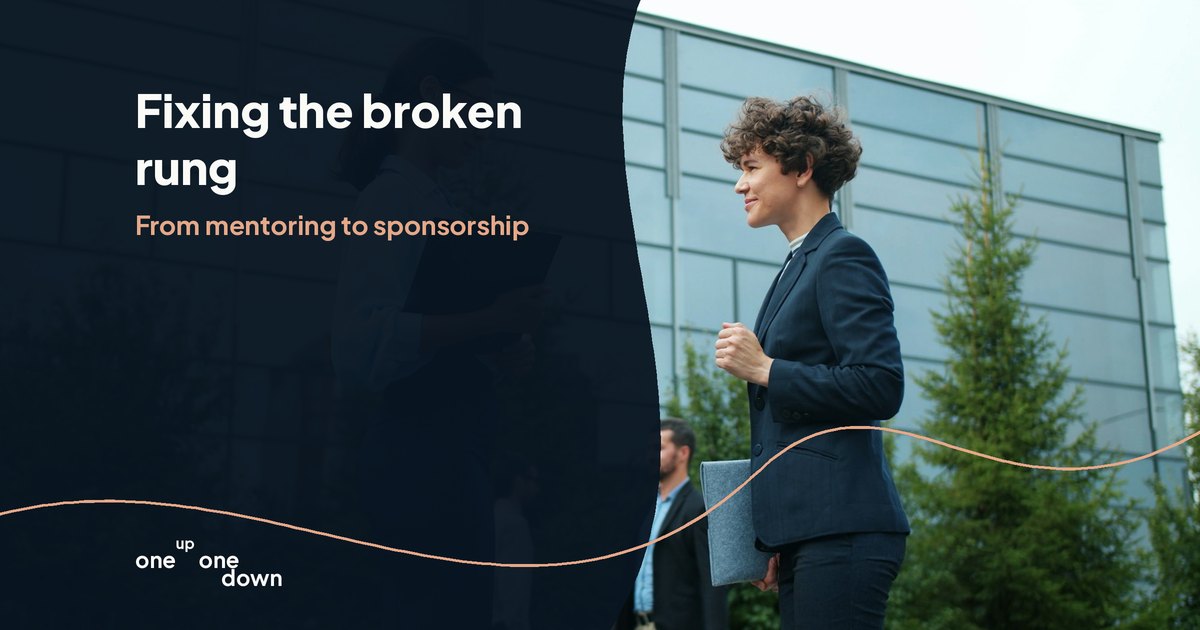
Most conversations about women in leadership start at the top. But the most important promotion in a woman's career usually happens much earlier, and much more quietly. It is the first step from individual contributor to manager. If she doesn't get that one, the rest never comes.
This is what McKinsey and LeanIn.Org call the "broken rung". Here is why that first rung leaks, the plain difference between mentoring and sponsorship, and a framework any organisation can run to move more women into management.
The broken rung, in numbers
In McKinsey and LeanIn.Org's Women in the Workplace 2025 report, only 93 women were promoted to manager for every 100 men. For women of colour, it was 74 for every 100 men.
Seven missing women per hundred might not sound dramatic, but it compounds. A woman who isn't promoted to manager can't be promoted to director later. The gap at the top is mostly built at the bottom.
You can see the result here in the UK. The FTSE Women Leaders Review 2026 shows real progress on boards: women now hold 43% of board roles across the FTSE 350, up from 9.5% when the Review began in 2011. But women hold 36% of leadership roles (executive committees and their direct reports), and only 8% of FTSE 350 CEOs are women.
Boards moved because they were measured. The executive pipeline depends on thousands of earlier promotion decisions that nobody watches as closely.
Why the first step is where pipelines leak
Promotion to manager is rarely decided on performance alone. It turns on visibility, the right work, and whether someone senior says your name when you're not in the room.
Two things get in the way for women.
The work itself. Researchers Linda Babcock, Brenda Peyser, Lise Vesterlund and Laurie Weingart found that in one professional services firm, women spent 200 more hours a year than their male colleagues on non-promotable work. To put that into perspective: women spend more than a month per year on dead-end assignments. That's the work that keeps an organisation running but doesn't get anyone promoted.
One of our co-founders knows this one personally. Earlier in her career she said yes to organising the office Christmas party. It was important to people, and nobody was ever promoted for it.
The advocates. The same McKinsey report found that employees with sponsors have been promoted at nearly twice the rate of those without over the past two years. Yet at entry level, 45% of men have a sponsor compared with 31% of women.
So women are doing more of the work that doesn't count, and have fewer people speaking up for the work that does. That is the broken rung.
Sponsorship vs mentorship: the plain difference
These two words get used interchangeably, but they do different jobs.
A mentor talks with you. Mentoring is a practice of guidance and reflection. A good mentor helps someone gain clarity, see what they already have, build confidence and decide what to do next. It is about growth, and it works best when the mentor is a few steps ahead rather than decades ahead. OneUpOneDown itself started with a mentoring match: our two co-founders were paired as mentor and mentee. They weren't decades apart. They were a few steps apart, which made it easy to learn from each other.
A sponsor talks about you. Sponsorship is advocacy. A sponsor is someone with influence who puts your name forward for a stretch project, a promotion or a role, and spends some of their own credibility doing it.
Put simply:
- Mentoring builds readiness: clarity, skills, confidence, a plan.
- Sponsorship creates opportunity: introductions, stretch assignments, a name in the talent review.
- Mentoring can be one or two steps up. Sponsorship needs someone with a seat where the decisions are made.
If you'd like a longer look at how mentoring differs from coaching, we cover that in mentoring vs coaching for women, and the wider case is in the benefits of mentoring for women.
Mentoring alone won't fix the broken rung. Sponsorship alone is hard to scale and tends to flow to people who are already visible. The answer is to connect them, so mentoring builds the readiness and visibility that sponsors act on.
The evidence that structured mentoring moves the dial is strong. In their Harvard Business Review study of 829 US firms over three decades, Frank Dobbin and Alexandra Kalev found that mentoring programmes boosted the representation of Black, Hispanic and Asian American women (and Hispanic and Asian American men) in management by 9% to 24%.
The mentoring-to-sponsorship ladder
This is a framework we've shaped from how we run programmes at OneUpOneDown: three-month matching cycles, four structured meetings per cycle (kick-off, check-in, deep dive and close), near-peer matching, and feedback collected at every stage. It runs over three cycles, so roughly nine months, for a defined cohort of women who are one step away from their first management role.
Cycle 1: Mentoring (months 1–3)
The goal: readiness and a clear plan.
Each participant is matched with a near-peer mentor, ideally someone who recently made the move to manager. The focus is clarity: what kind of manager she wants to be and what is in her way.
What HR does:
- Define the cohort with clear, published criteria.
- Match on goals and experience, not just job title or department.
- Ask each participant to map her current workload into promotable and non-promotable work, and share that picture with her line manager.
What to measure:
- Share of matches that hold a first meeting and complete all four.
- Match quality ratings after the first meeting and at the close.
- Each participant leaves with a written 6-month development goal.
Cycle 2: Visibility (months 4–6)
The goal: make her work seen by the people who decide promotions.
She is rematched with a mentor further up or in another function, to widen her network, and takes on one visible stretch piece: leading a project or presenting to a senior team.
What HR does:
- Work with line managers to agree one stretch assignment per participant, and rebalance some non-promotable tasks to make room for it.
- Create small-group moments where participants meet senior leaders, so names are familiar before cycle 3.
What to measure:
- Percentage of participants with an agreed stretch assignment.
- Change in self-reported confidence and readiness for a management role.
Cycle 3: Sponsorship (months 7–9)
The goal: a named senior advocate for every participant.
Each participant is paired with a sponsor at a level where promotion decisions are made. The sponsor's role is explicit and written down: understand her ambitions, put her forward for at least one concrete opportunity, and speak for her in the next talent or succession review.
What HR does:
- Recruit sponsors and give them a short, clear brief on what sponsorship means (it is not more mentoring).
- Build sponsor actions into the talent review process so they happen and are recorded.
What to measure:
- Percentage of participants with an active sponsor.
- Number of concrete opportunities sponsors created (roles, projects, introductions).
- Promotion rate to manager at 6 and 12 months, compared with a similar group outside the cohort.
- Retention of the cohort over the same period.
The last two numbers are what your board will care about. The earlier ones tell you whether it's working while there is still time to adjust.
One caution: mentoring is often unrecognised work itself. Recognise mentors and sponsors properly, or the programme adds to the problem it is trying to fix.

A careful note on positive action
Programmes designed for women are common in the UK, but positive-action measures are lawful only within certain limits, and offering development support is not the same as deciding who is promoted. Please take your own legal advice before designing or launching a programme like this, particularly on eligibility criteria and how sponsorship links to promotion decisions.
Where to start
You don't need to build all of this at once. Most organisations already have the women leaders their rising talent needs. They just haven't been connected yet.
At OneUpOneDown we've sent over 11,000 match proposals across programmes of 100 to 2,000 members in 170+ countries. 89% of members rate their match 4 or 5 (4.5/5 from 3,880 reviews), and after the first meeting 93% of mentees name at least one concrete gain. In the FIA Women in Motorsport programme, 271 participants from 69 countries made 280 matches in the first nine months. We run the matching, reminders, feedback and reporting, so HR can focus on the parts only HR can do: the stretch work, the sponsors and the talent review.
If you're thinking about how to fix the broken rung in your own organisation, we're happy to jump on a call and talk it through. Book a demo.
FAQ
What is the broken rung for women? The broken rung is the gap at the first promotion from entry level to manager. In McKinsey and LeanIn.Org's Women in the Workplace 2025, 93 women were promoted to manager for every 100 men, and 74 women of colour. Because later promotions depend on this one, the gap compounds all the way up.
What is the difference between sponsorship and mentorship? A mentor talks with you: they offer guidance, perspective and a sounding board to help you grow. A sponsor talks about you: they use their influence to put you forward for roles, projects and promotions. Women need both, and organisations get the best results when mentoring leads into sponsorship.
How long does it take to move women into management with a programme like this? The ladder runs over three three-month cycles, roughly nine months. Promotion outcomes take longer, so track promotion and retention at 6 and 12 months after the cohort ends.
Can a women-only mentoring or sponsorship programme be run in the UK? Many UK organisations run them, but positive action is lawful only within limits. Take your own legal advice on eligibility and on how any programme connects to promotion decisions.
Sources
- McKinsey & Company and LeanIn.Org, Women in the Workplace 2025 (93 women promoted to manager per 100 men; 74 women of colour; employees with sponsors promoted at nearly twice the rate; 45% of entry-level men vs 31% of women have sponsors): https://www.mckinsey.com/featured-insights/diversity-and-inclusion/women-in-the-workplace
- FTSE Women Leaders Review, 2026 report press release (43% of FTSE 350 board roles, up from 9.5% in 2011; 36% of leadership roles; 8% of FTSE 350 CEOs): https://ftsewomenleaders.com/wp-content/uploads/2026/02/ftse-wlr-2026-report-press-release-final-version.pdf
- Frank Dobbin and Alexandra Kalev, "Why Diversity Programs Fail", Harvard Business Review, July–August 2016 (mentoring programmes raise representation of Black, Hispanic and Asian American women, and Hispanic and Asian American men, in management by 9% to 24%): https://hbr.org/2016/07/why-diversity-programs-fail
- Linda Babcock, Brenda Peyser, Lise Vesterlund and Laurie Weingart, The No Club (2022); 200 more hours a year of non-promotable work in one professional services firm, as described by Lise Vesterlund, UC Berkeley Haas O'Donnell Center interview: https://haas.berkeley.edu/behavioral-economics/news/ocbe-interviews/the-no-club-lise-vesterlund
- OneUpOneDown platform data, November 2026 (over 11,000 match proposals, 170+ countries; 4.5/5 from 3,880 reviews, 89% rating 4 or 5; 93% concrete gain) and community size (10k+ members): https://oneuponedown.org/impact/
- FIA Women in Motorsport case study (271 participants, 69 countries, 280 matches in 9 months): https://oneuponedown.org/case-study-fia-women-in-motorsports-mentorship-programme/
Cover photo: Vitaly Gariev on Unsplash
Free white paper
Connected, not created: the business case for women’s mentoring programmes
The research, the numbers and the tools to take a proposal to your leadership team: an ROI worksheet, a 30-day launch checklist and a board reporting template.
You might also like
For organisations
Why the best mentor is a few steps ahead, not decades ahead
Near-peer mentoring pairs people a step or two apart. Why it solves the mentor supply problem, and a matching framework that leads to first meetings.
2 November 2026
For organisations
How associations use mentoring to grow member value (and prove it)
How associations, federations and sports bodies run a member mentoring programme people use, fund it, keep it alive between cycles and report its value.
29 October 2026
For organisations
Women's mentoring programmes for organisations: a UK guide
How UK organisations design, launch and measure a women’s mentoring programme: near-peer matching, three-month cycles, a four-week launch plan and a one-page board template.
19 October 2026