
Women's mentoring programmes for organisations: a UK guide
How UK organisations design, launch and measure a women’s mentoring programme: near-peer matching, three-month cycles, a four-week launch plan and a one-page board template.
OneUpOneDown · 19 October 2026 · 10 min read
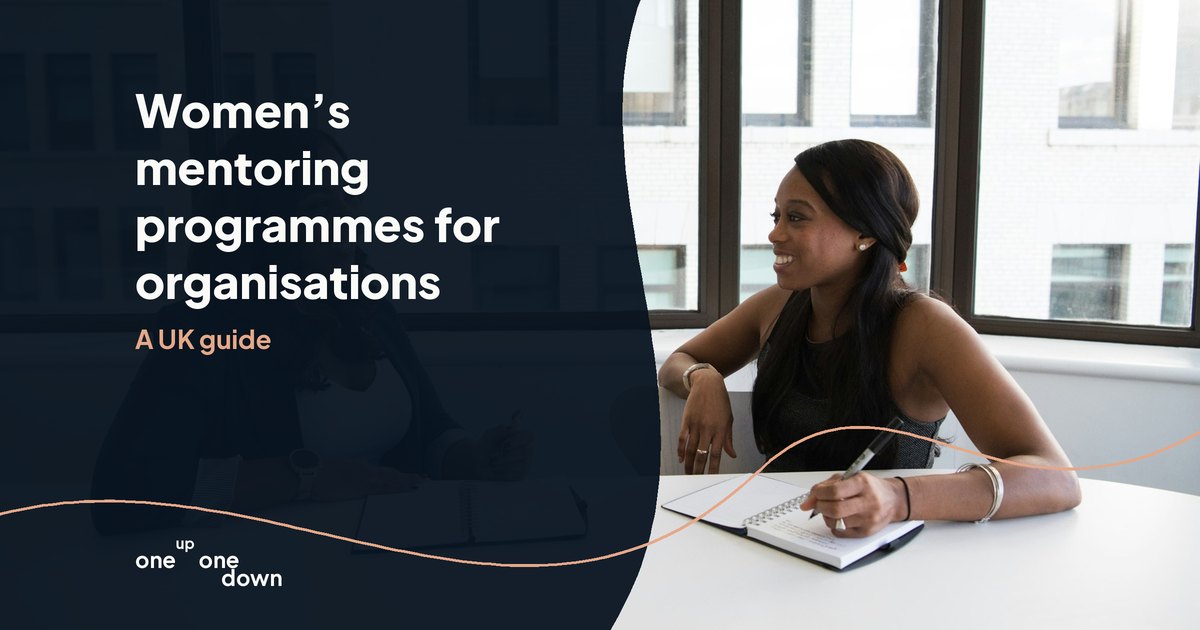
Most organisations already have the women leaders their rising talent needs. They just haven't been connected yet.
That's the conversation we have most often with HR teams and association leaders. The talent is there. What's missing is a structure that puts the right people together, keeps them meeting, and shows the board it made a difference.
That structure is what we build at OneUpOneDown, and it's the thread through this guide. If you're an HR, L&D or inclusion lead, or you run an association or sports body, this is a practical look at why organisations run women's mentoring programmes, what good looks like, how to launch one and how to show your board it worked.
Why organisations run women's mentoring programmes
We always think "why now?" is an important question. The UK numbers give a clear answer.
The FTSE Women Leaders Review 2026 reports that women now hold 43% of board roles across the FTSE 350, up from 9.5% when the Review began in 2011. That's real progress. Below the board it's slower. Women hold 36% of leadership roles (executive committees and their direct reports), up from 32% in 2021. Only 8% of FTSE 350 CEOs are women, and 17% of chairs.
The gap opens early. McKinsey and LeanIn.Org's Women in the Workplace 2025 (US data, but the pattern is familiar to anyone in UK HR) found that only 93 women were promoted to manager for every 100 men, and 74 women of colour. This is the "broken rung": the first step into management, where the pipeline quietly narrows.
The same report found that employees with sponsors have been promoted at nearly twice the rate of those without. At entry level, 45% of men have a sponsor, compared with 31% of women.
So the problem isn't a lack of talented women. It's a lack of connection. Most organisations already have the women leaders their rising talent needs. They just haven't been connected yet.
There's a business case too. In the Association of Business Mentors' 2025 report on UK workplace mentoring, 66% of businesses said their mentoring and coaching programmes had boosted retention and talent attraction, and 70% said they had a positive impact on overall business performance.
If you want the individual side of the story, our piece on the benefits of mentoring for women covers what participants get out of it.

What a good women's mentoring programme looks like
Over the years we've seen programmes thrive and we've seen them fade. The difference usually comes down to five things.
1. Near-peer matching
A mentor one or two steps ahead is often more useful than one ten steps ahead. She remembers the problem, she's close enough to be relatable, and she's still learning herself.
Near-peer matching also solves the question every programme owner asks: "Where will we find enough mentors?" When people can be both mentor and mentee, your pool grows from the middle. In the FIA Women in Motorsport programme, 58% of participants chose to be both.
2. Structure without bureaucracy
Pairs need a light shape to follow. The one we use is three months and four meetings:
- Week 1: kick-off. Agree goals and how you'll work together.
- Week 4: check-in. What's moving, what's stuck.
- Week 8: deep dive. Work through one real challenge.
- Week 12: close. Review progress and decide what's next.
3. Short cycles with rematching
Year-long matches sound generous, but they're hard to commit to and hard to exit. Three-month cycles give people a clear finish line. Good matches can be extended, poor ones can end early without awkwardness, and everyone gets a fresh match when they need one. This is what keeps a programme alive past the first cohort.
4. Matching that someone actually checks
Matching on goals, experience and compatibility matters more than matching on job title. We use AI matching, with a human matchmaker who reviews every pair. Technology handles the volume. People catch the things a form can't.
5. Measurement from day one
If you only count sign-ups, you'll only be able to report sign-ups. Decide what you'll measure before launch (more on that below).
In-house, platform or consultancy: an honest comparison
There are three broad ways to run a women's mentoring programme. Each one suits different organisations, and we'd rather you pick the right one than the wrong one with us.
Run it in-house (spreadsheets, forms and goodwill)
- Best for: a small pilot, one site or one team, with a programme owner who has real time to give.
- Watch out for: the admin. Matching, chasing, rematching and reporting take far more hours than people expect. In the Association of Business Mentors' 2025 report, UK HR leaders named lack of time (47%) and difficulty matching mentors and mentees (39%) as their top barriers.
Use a mentoring platform
- Best for: programmes of more than a few dozen people, or anything that needs to run across sites, organisations or countries.
- Watch out for: software that leaves the work with you. Some platforms give you the tools, and your team still does the matching, nudging and reporting. Ask who does what after launch.
Hire a consultancy
- Best for: a small, high-touch leadership cohort with facilitated workshops, where the design work is the main value.
- Watch out for: cost per head and scale. It's hard to extend a bespoke design to hundreds of women or keep it running year after year.
OneUpOneDown sits between the last two: a platform with a team that runs the programme for you. You invite people. We handle matching, reminders and reporting. If your need is a 12-person executive cohort with in-person workshops, a consultancy may honestly suit you better.
A four-week launch plan
Setting up your programme takes us 24 hours. What takes longer is the thinking and the inviting, and that part is yours. Here's how a typical first month breaks down.
Week 1: plan
- Agree who the programme is for: all women, a career stage (e.g. first-time managers), a function, or a wider community.
- Set two or three goals you can measure (see the next section).
- Decide size, launch date and who signs off.
Week 2: set up
- Your branded programme space is set up for you within 24 hours.
- Review the matching questions and customise them for your organisation, e.g. whether people can be matched inside their own team.
- Agree what you'll report and to whom.
Week 3: invite
- Send the launch message to your participants using ready-made templates.
- Ask two or three senior women to sign up as mentors first and say so publicly. It does more for sign-ups than any poster.
Week 4: match and kick off
- Participants complete their profiles and are matched. Every pair is reviewed before the proposal goes out.
- Pairs book their first meeting. Reminders and scheduling are handled for them.
From there, the 12-week cycle runs, feedback is collected along the way, and you see it all in a live dashboard.
How to measure impact and report it to your board
Boards don't need more data. They need the right four or five numbers and a story that makes them real. We'd suggest building your report in four layers.
1. Reach: who took part
- Number of participants, split by mentor, mentee and both
- Which levels, functions or sites they came from
2. Rhythm: did pairs actually meet
- Share of pairs who held a first meeting
- Average meetings per pair across the cycle
3. Quality: was the match right
- Match rating after the first meeting and at the end of the cycle
- Share of pairs who chose to extend
4. Outcomes: what changed
- Goals achieved, in participants' own words
- Confidence and clarity, measured before and after
- Retention and promotion of participants compared with similar colleagues who didn't take part, tracked over 12 months
Then add two short participant stories. Numbers earn the board's attention. Stories earn their support.
A one-page board template
You can lift this as it is:
Programme: [name], cycle [number], [dates] Reach: [x] participants ([x] mentors, [x] mentees, [x] both) Rhythm: [x]% of pairs met; average [x] meetings per pair Quality: average match rating [x]/5 at close Outcomes: [x]% achieved their main goal; retention of participants [x]% vs [x]% for comparison group In their words: two quotes Next cycle: what we're changing and why
Susanna Coletta, Project Coordinator for FIA Women in Motorsport, put it this way when describing working with us: "They have shown immense dedication in supporting our requests, particularly in collecting data, stories, and feedback from our users." That's the part that turns a programme into a case your sponsors can back.
A short example: FIA Women in Motorsport
The FIA launched its Women in Motorsport Mentorship Programme in 2024, powered by OneUpOneDown. In the first nine months it brought together 271 participants from 69 countries and made 280 matches, with a 93% success rate on match satisfaction.
After more than 850 women applied in the first cycle, the FIA announced it would expand the programme from 300 to 500 places for 2025.
Motorsport is a male-dominated industry spread across many countries and roles. If near-peer matching and short cycles work there, they travel well. You can read the full FIA case study.

Common mistakes (and how to avoid them)
Pairs who never meet. This is the quiet failure of most programmes. Chronus's State of Mentoring 2026 survey of HR leaders found that 39% of participants are matched but never schedule a first meeting, and 54% meet once and don't continue. Fix it with a clear week-one kick-off, calendar booking built into the match, and reminders that come from the programme, not from you. On OneUpOneDown, 74% of pairs hold their first meeting, against the 61% the Chronus figures imply, and 79% of pairs that start go on to complete.
Matching on title alone. A senior name doesn't make a good mentor for everyone. Match on goals and context, and have a person check every pair.
Making it a one-off. A launch event and a single cohort create a spike, then silence. Three-month cycles with rematching keep momentum.
Running out of mentors. Senior women are often asked to do everything. Near-peer matching spreads the load and lets more women give back.
Measuring the wrong thing. Sign-ups are easy to count and say little. Track meetings, match quality and progression.
Leaving sponsorship out. Mentoring builds clarity and confidence. Sponsorship opens doors. Invite senior leaders into the programme so the best conversations can lead to real opportunities.
FAQ
How long does a women's mentoring programme run?
We run matches in three-month cycles of four meetings, then rematch. Most organisations run continuously across the year, with participants joining new cycles as their goals change. That rhythm is easier to commit to than a single year-long match.
How many people do we need to get started?
Fewer than you might think, as long as you have a mix of experience. Near-peer matching means many participants can mentor and be mentored at the same time, so you don't need a large pool of senior mentors before you start. If you'd like to talk through numbers for your organisation, we're happy to.
Can we run a mentoring programme only for women in the UK?
Many UK organisations, associations and sports bodies run women-focused programmes. The rules on positive action are specific, so take your own legal advice on eligibility and how you describe the programme. Some organisations also open a parallel programme for everyone and keep a women-focused strand within it.
What does a women's mentoring programme cost?
It depends on the number of participants and how much support you need. We offer fixed-price and sponsor-funded models, and in our experience a well-run mentoring programme comes in at a fraction of the cost of external coaching. We share pricing on a call once we understand your goals.
How is a mentoring programme for women employees different from coaching?
A coach is usually a paid professional working to a defined brief. A mentor is someone a few steps ahead who shares experience and helps you find your own answers. Mentoring scales to many more people, and the mentors grow too. For more on the model, see our page on mentorship for women.
If you're thinking about a programme
Mentorship helps people gain clarity, take action and embody leadership. For organisations, it isn't a nice-to-have. It's part of the solution to the broken rung.
If you're weighing up a women's mentoring programme, or trying to fix one that has stalled, we're happy to jump on a call and talk it through. No pitch, just a conversation about what you're trying to achieve.
Sources
- FTSE Women Leaders Review 2026, press release (Feb 2026, data as at Oct 2025): https://ftsewomenleaders.com/wp-content/uploads/2026/02/ftse-wlr-2026-report-press-release-final-version.pdf
- McKinsey & LeanIn.Org, Women in the Workplace 2025 (US data): https://www.mckinsey.com/featured-insights/diversity-and-inclusion/women-in-the-workplace
- Association of Business Mentors, "Unlocking Impact" workplace mentoring and coaching report (Oct 2025): https://associationofbusinessmentors.org/workplace-mentoring-coaching-report-2025/
- Chronus, State of Mentoring Survey 2026 (n=94 HR leaders; vendor research): https://chronus.com/news-and-events/chronus-state-of-mentoring-survey-2026
- FIA, "FIA expands Women in Motorsport Mentorship programme for 2025" (21 Aug 2024): https://www.fia.com/news/fia-expands-women-motorsport-mentorship-programme-2025
- OneUpOneDown, FIA Women in Motorsport case study: https://oneuponedown.org/case-study-fia-women-in-motorsports-mentorship-programme/
- OneUpOneDown, programme structure and launch timeline: https://oneuponedown.org/women-in-football/ and https://oneuponedown.org/platform-how-it-works/
Cover photo: Christina @ wocintechchat.com M on Unsplash
Free white paper
Connected, not created: the business case for women’s mentoring programmes
The research, the numbers and the tools to take a proposal to your leadership team: an ROI worksheet, a 30-day launch checklist and a board reporting template.
You might also like
For organisations
Fixing the broken rung: how mentoring and sponsorship move women into management
The first step to manager is where women’s careers stall. The plain difference between mentoring and sponsorship, and a three-cycle ladder any organisation can run.
6 November 2026
For organisations
Why the best mentor is a few steps ahead, not decades ahead
Near-peer mentoring pairs people a step or two apart. Why it solves the mentor supply problem, and a matching framework that leads to first meetings.
2 November 2026
For organisations
How associations use mentoring to grow member value (and prove it)
How associations, federations and sports bodies run a member mentoring programme people use, fund it, keep it alive between cycles and report its value.
29 October 2026