
Standing Up With Authority: Lukudu Elisa on Mentoring Through Emergency WASH Response

Lukudu Elisa
WASH Programme Manager, Tearfund · South Sudan
Mentor · WIW & RWSN · 24 October 2026
“Mentorship plays an indispensable role by safeguarding institutional knowledge and bridging the divide between theoretical engineering and public health principles and field-tested operational realities.”
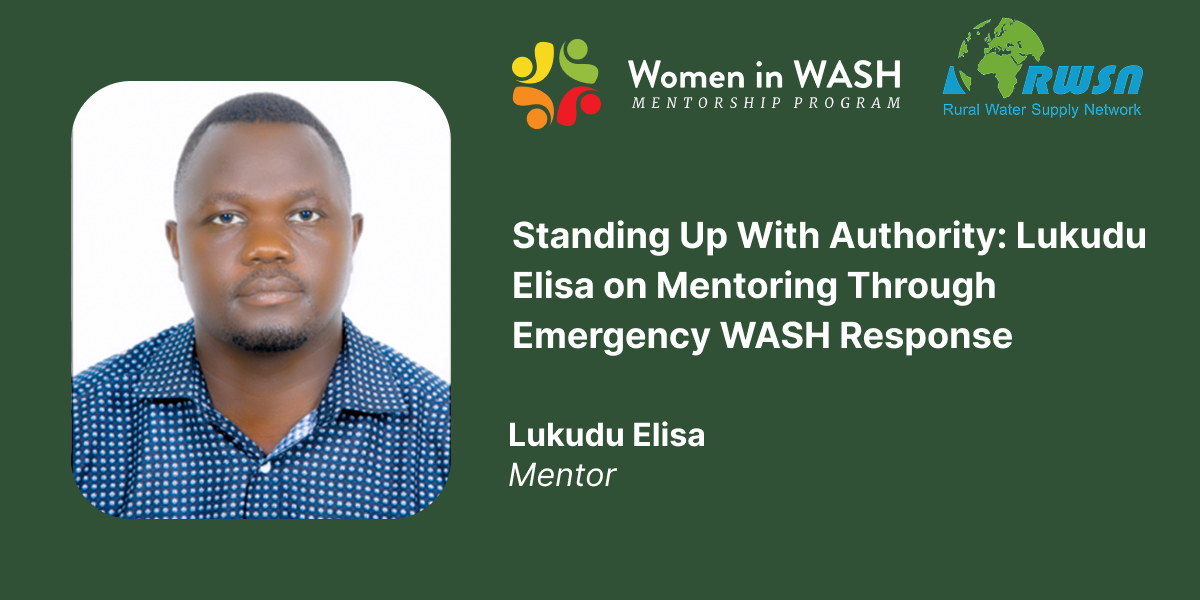
Lukudu Elisa is based in Juba, South Sudan, where he works as a WASH Programme Manager with Tearfund, leading emergency and long-term community water supply, sanitation, and hygiene promotion initiatives across vulnerable communities.
Lukudu takes part in the Women in WASH & RWSN mentorship programme as a mentor.
Learning That Textbooks Aren’t Enough
Lukudu traces his decision to mentor back to his early field experience, navigating emergencies from cholera outbreaks to drought response. “Rigid textbooks couldn’t replace the wisdom of seasoned humanitarian leaders. I realized that technical skills mean very little if local staff lack the confidence, resilience, and problem-solving skills to adapt on the ground.”
What he finds most rewarding is watching that shift happen in someone else. “The most rewarding part of mentoring is watching a junior engineer or field officer transition from seeking constant direction to confidently designing community-led WASH solutions, managing field risks, and advocating for vulnerable households independently.”
A Defining Moment During a Flood Response
During a major flood emergency, Lukudu mentored a young female WASH officer who had strong technical skills but hesitated to speak up in inter-agency coordination meetings dominated by international stakeholders. Over several months, they worked together on stakeholder management, field data presentation, and situational leadership.
During a critical coordination meeting on cholera prevention, the officer took the lead, presented the team’s WASH assessment data clearly, and successfully advocated for clean water truck routes to be redirected to an overlooked displacement camp. “Seeing her stand up for those displaced communities with authority and passion was a defining moment for me.”
How Mentoring Has Shaped Him
Lukudu describes mentoring as forcing him to examine his own decision-making. “To guide someone else effectively through complex WASH challenges, such as community resistance to sanitation changes or resource constraints, I have to break down my own decision-making processes. It has sharpened my communication skills, built my patience, and exposed me to fresh, innovative ideas from younger professionals who view long-standing humanitarian problems through new lenses.”
His Advice to First-Time Mentors
Lukudu encourages new mentors not to wait for a sense of complete mastery. “Do not wait until you feel like you ‘know everything,’ you never will. What you need is a willingness to listen, share your lived experiences including your mistakes, and walk alongside someone.” He frames the goal of mentorship specifically. “It is about asking the right questions so the mentee can find their own footing.”
Why He Believes Mentorship Matters
Lukudu connects mentorship directly to the demands of humanitarian WASH work. “Mentorship plays an indispensable role by safeguarding institutional knowledge and bridging the divide between theoretical engineering and public health principles and field-tested operational realities.” He also points to its role beyond technical guidance. “Given the profound emotional and physical demands inherent to humanitarian practice, a dependable mentor offers essential strategic guidance and critical psychological support.”
What He Recommends
When asked for a book, tool or resource recommendation, Lukudu points to two field references. “The Sphere Handbook (specifically the Water Supply, Sanitation, and Hygiene Promotion standards), alongside the Emergency Sanitation Manual by WEDC. The Sphere standards provide the absolute essential humanitarian baseline for dignity and health, while WEDC offers indispensable practical engineering guidance for field implementations in challenging environments.”
