
A Space Still Dominated by Men: Tonderai Mhuru on Learning What Persistence Really Takes

Tonderai Mhuru
Hydrogeologist, Regmax Engineering · Zimbabwe
Mentee · WIW & RWSN · 24 October 2026
“I joined as a mentee, motivated by the opportunity to network and gain access to senior professionals with deep technical expertise in the sector.”
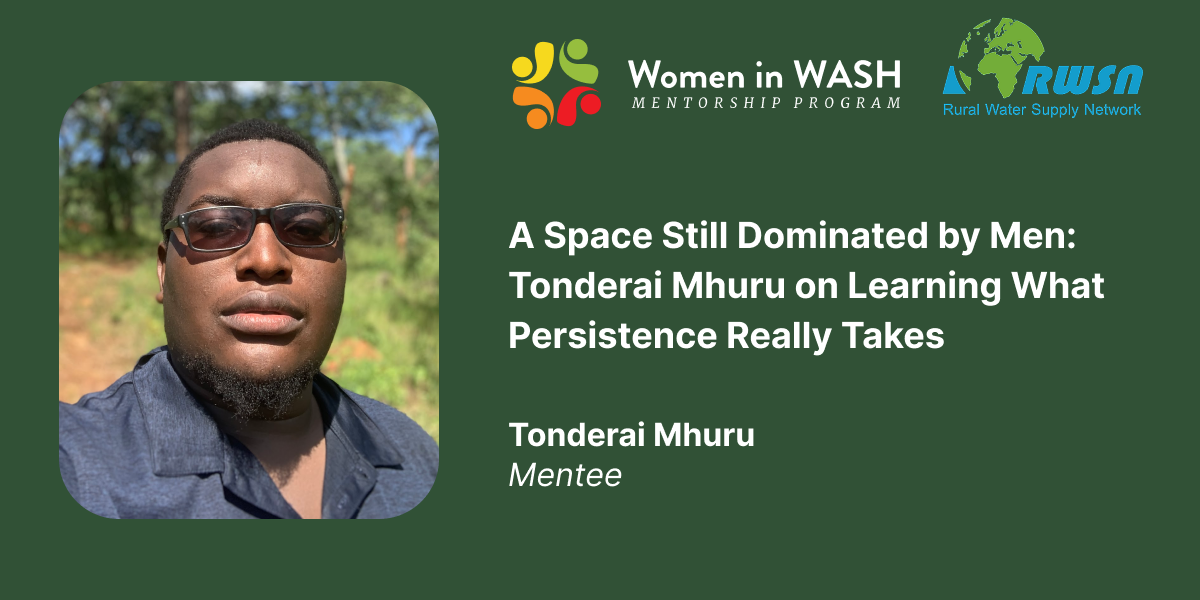
Tonderai Mhuru is based in Zimbabwe, where he works as a hydrogeologist at Regmax Engineering. With over five years of field experience in groundwater resource management, his work spans borehole siting, drilling supervision, geophysical surveys, pumping-test analysis, and WASH programming. He has partnered on projects with USAID, CESVI, World Vision, Oxfam, and UNDP.
Tonderai joined the Women in WASH & RWSN mentorship programme as a mentee.
Looking for Access to Senior Technical Expertise
Tonderai’s motivation for joining was straightforward. “I joined as a mentee, motivated by the opportunity to network and gain access to senior professionals with deep technical expertise in the sector.”
A Shared Regional Context
What made the mentorship relationship feel grounded for Tonderai was a shared background with his mentor, who is based in Malawi and works at BASEFLOW. “That shared regional context made our conversations feel grounded and immediately relevant, not abstract.”
Understanding What It Actually Takes to Grow in the Field
The moment that stood out most to Tonderai was hearing his mentor’s own career story. “Hearing how she built her career and earned her place in the field gave me a clearer, more honest picture of what it actually takes to grow in this industry, not just the technical competence, but the sheer determination required to keep pushing forward in a space still dominated by men. It reframed how I think about persistence in my own career.”
What Stood Out About His Mentor
Tonderai points to his mentor’s openness about both the technical and practical sides of the work. “Her willingness to share both technical knowledge and the bureaucratic, on-the-ground realities of working in this field, made easier by the fact that we’re from the same region and understand similar systems and challenges.”
Rethinking What Mentorship Offers
Tonderai had expected mentorship to be mostly about technical pointers. “This experience showed me it’s just as much about perspective and understanding how someone navigated the same industry, the same regional constraints, and came out the other side. That’s harder to get from a textbook or a training course, and it’s changed how deliberately I now seek out that kind of guidance.”
His Message to Anyone Considering the Programme
Tonderai encourages people to set aside hesitation about putting themselves forward. “The value of having someone with real, regionally relevant experience in your corner far outweighs it, and you’ll likely come away with more clarity about your own path than you expected.”
What He Recommends
When asked for a book, tool or resource recommendation, Tonderai points to two foundational texts in hydrogeology. “Groundwater by Freeze and Cherry; it’s the classic reference text in the field. Still, it shapes how hydrogeologists think about aquifer systems decades after it was written.” For something more applied, he adds Applied Hydrogeology by C.W. Fetter as “a great companion.”
